
Spiky founders
On knowing your spikes: when superpowers become derailers

High bar. Intense. Mission driven. Demanding.
Spiky. Unreasonable. Contrarian. Founder mode. Wartime CEO.
Egomaniacal. Partly delusional. A little bit unhinged. Slightly insane, in the best way.
These are not insults. Every word on that list has been used approvingly, in writing or in public, by serious investors describing the founders they most want to back.
The polite cluster lives in job ads and board updates. “High bar” is how founders describe themselves. “Demanding” is what their Chief of Staff says in interviews when they’re being diplomatic.
The middle cluster is the prevailing narrative. “Spiky,” “founder mode,” “wartime CEO”. This is venture vocabulary now. “Founder mode” came from a Brian Chesky anecdote, written up by Paul Graham in 2024. In the founder circles I know, it’s mostly used ironically. “Wartime CEO,” on the other hand, I have heard said with complete sincerity, several times. Underneath it all, the thesis is that exceptional companies are built by unusual people.
The vocabulary is deliberate. Susa Ventures wrote it directly into their investment thesis: the ideal founder “spikes”, i.e. they are top one percent on some trait - or, put more bluntly, “a well‑rounded person is a mediocre person”. Doug Leone at Sequoia calls it being “two standard deviations away from the normal type of person.” Andreessen Horowitz’s original LP pitch used one word: egomaniacal.
The logic makes sense: venture capital is a power law game. Asymmetric returns require asymmetric people. You can’t fund the median and expect the outlier.
So the ecosystem built a pipeline for spiky founders. And those founders go on to build companies. And those companies need teams.
Tuesday afternoons
I get the pull. I cannot tell you how many times I have excitedly proclaimed “I love spiky people!”, and I genuinely do. Understanding and uncovering those traits, preferences, and what gets people up in the morning, then pointing them in a direction where they make magic, is my jam.
But there is a massive difference in having a visionary idea, and building a functioning company.
These same “spiky” traits are very different things depending on which side of the pitch deck you’re on. It’s my belief that great founders create brilliant but complicated cultures.
Here’s a list I’ve borrowed (from Pratyush Buddiga at Susa Ventures). He looks for founders who are:
Technical, but also commercial
Have a chip on their shoulder
First principles thinker
This is their life’s work
Insanely big vision and ambition
Relentless
Adaptable learning machines
From an investor’s side of the pitch deck, this list looks thrilling. You see conviction, speed, irrational commitment, and a mind that doesn’t accept the obvious answer. But from the team’s side, you actually have to live with these things. You experience them as standards, priorities, decisions, and the pressure you feel on a Tuesday afternoon in June.
If you put that list through a trait based lens, “spiky” is almost literal. When you score very high or very low on certain traits, you sit further away from the middle of the population - you are, by definition, a deviation. Personality doesn’t explain everything on that list (it mixes ability, motivation, and worldview as well), but it is a useful way to understand why certain motives and behaviours show up.
Our development areas are usually overplayed strengths
I am not saying this trait list is hard to be on the other side of because these exceptional people (the 1%!) are toxic. I agree they’re strengths. But our strengths are usually the exact things that get in our way and trip us up the most.
When you’re tired, stressed, under pressure, or just not actively monitoring your behaviour (conditions that describe most weeks as a startup founder), your “bright side” traits turn up too high. They become what Hogan personality assessments called derailers.
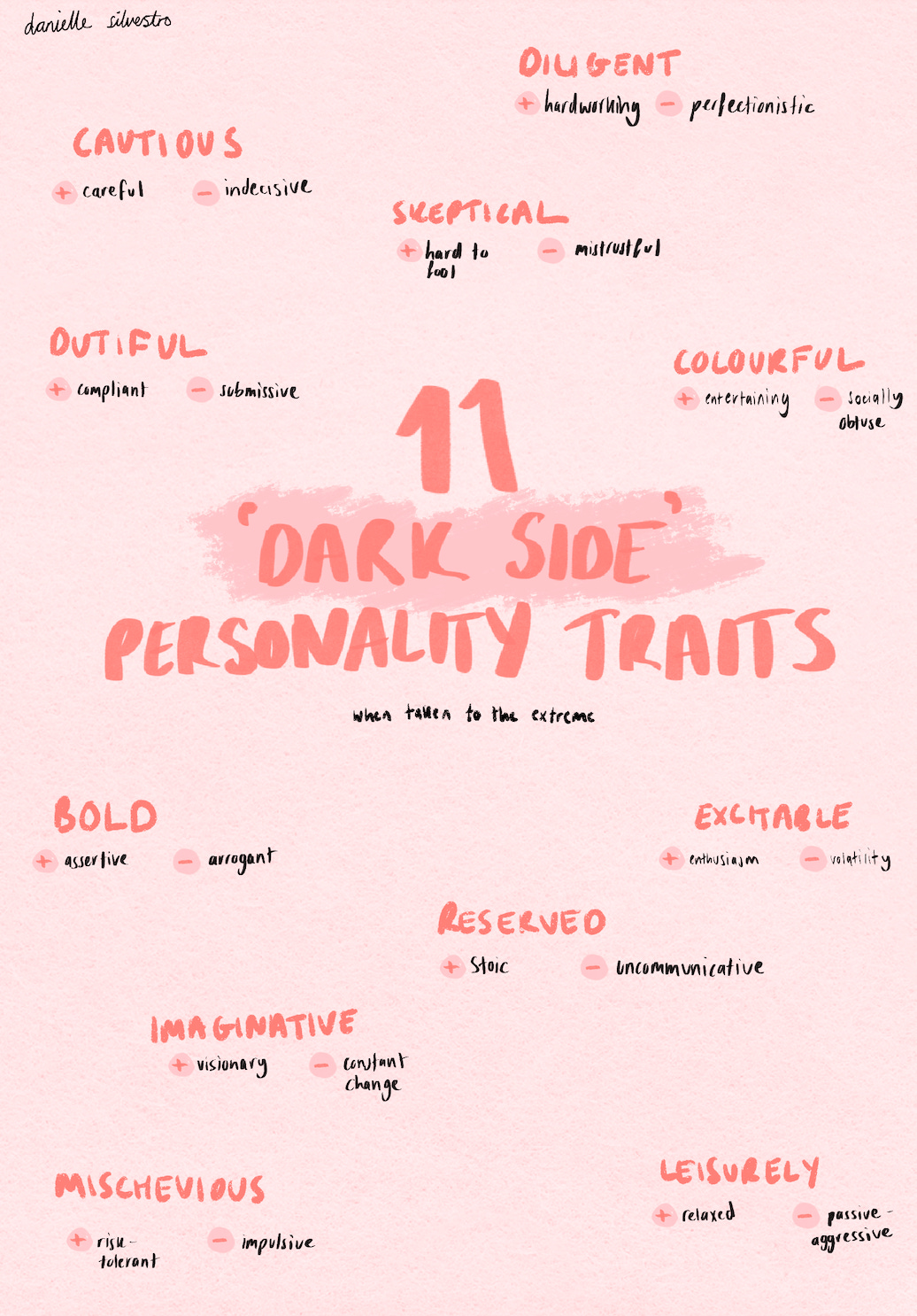
Image: how Hogan talks about ‘the dark side’ of strengths.
Look at how quickly a fundraising asset becomes an operational liability:
Relentless is a strength. It’s the reason the company exists at all. Overplayed, it is the reason the team works 996, says yes to every possible project, and feels like they can never take a holiday without falling permanently behind.
Having a chip on your shoulder fuels grit, ambition, and a refusal to accept mediocrity. Overplayed, it becomes a bar that says nothing is ever quite good enough. It sucks the joy out of winning (or making progress) because you immediately move onto the next thing you need to prove.
Treating a company as your life’s work is the difference between a job and mission. There is a lot of research on how having a “calling” is a double edged sword, which, if you’re a founder, is worth reading. Overplayed, it is why people burn out sprinting at every problem, or why you burn out yourself in pursuit of the vision.
Some of the things I’ve seen
In my work, I’ve done over 30 highly detailed founder assessments and debriefs, and countless more with members of their teams.
Whilst we don’t yet have a definitive “founder personality” profile, there are hints in the research, for example around openness, novelty seeking and emotional resilience1, but nothing that really matches the myth.
What I do have is a small but deep sample. And in that sample, the same pattern keeps appearing.
Most founders I work with have at least one trait that sits well away from the middle.
That spike is often part of what makes them brilliant. It gives them range, intensity, originality, conviction, or pace. But when that same spike gets overused, it stops being just a personal preference and starts shaping the culture around them.
That doesn’t mean you have to be extreme to build something great. It just means that if you are, you can’t pretend those spikes are neutral for your culture.
Overplaying your strengths
See if you recognise any of these four common (enough) archetypes:
The thinker
They spike in cognitive strategy.
At their best: they raise the level of thinking in every room.
In overdrive: they severely underestimate the boring middle. Once the novelty wears off, their attention shifts to the next interesting problem, leaving a trail of half-finished “brilliant starts” for the team to clean up.
The designer
They want craft, coherence, and seamless execution.
At their best: they raise everyone’s standards.
In overdrive: nothing is ever ready to ship. Decisions slow down, timelines stretch, and the team learns to second guess everything before sharing it.
The hype person
When they’re excited, their energy is contagious. They feel like walking dopamine.
At their best: if their work is landing, the whole company feels it.
In overdrive: any lack of external recognition hits them hard. They feel overworked, under recognised, and slighted, and the team pivots from managing their own work to managing the founder’s mood.
The conflict avoider
They are thoughtful, inclusive, and want to create space to hear from others.
At their best: they create genuine buy in.
In overdrive: they say positive things in a meeting, then vent their frustration in the background to their co-founder or leadership team. The team is left operating under the illusion of alignment, when really they’re on completely different pages.
This is what a brilliant but highly complicated culture feels like in reality. The spike is real, and it creates something that is worth building. It’s just not very tidy to work in.
Working with your spikes
There is an oft repeated startup myth that “everyone is responsible for the culture.” In reality, the culture IS the founders.
Other people on your team will have spikes too. Some of them might even look a lot like yours. The difference is they don’t sit in the same position of power that you do. Power makes spikes more prominent. It turns a preference into a norm, a mood into a weather system (truly), and a quirk into “this is how things are done here.”
This is why I use tools like the Hogan assessment with founders. It doesn’t measure how you see yourself; it measures reputation. It gives you a shortcut into understanding how other people actually experience you, forcing you to look directly at your blind spots.
If you are going to build an outlier company, you can’t smooth out your edges. You need those spikes. But you have to learn to manage them when they are working against you (which they will).
At a minimum, it means doing the following:
Get honest about your reputation. This is not who you think you are; it’s how other people experience you. That means asking for real feedback, listening without defending, and paying attention to what people manage around you, e.g. the topics they avoid and the things they sugar coat.
Name your overdrive behaviours. Identify your strengths and ask “what does this look like when it’s too much?” Are you never satisfied? Do you struggle reaching a quality bar before shipping? Do you experience emotional swings? Do you become passive aggressive? Put language around those, so your team can see them too. Do the work to see it in yourself, this isn’t always easy but my god, it has a high ROI.
Design complementary spikes into the team. Don’t just hire “culture fits” who feel like you. It’s so, so easy to do (one of my most startling discoveries running trait based personality assessments is how often teams share a very similar profile). Hire people whose natural spikes offset your overdrive – the completer‑finisher, the person who loves to ship and test, the calm operator. Give them real power to play to their strengths, even if it means getting out of their way.
Build structures and ways of working that actually fit you. This is where most “best practice” advice falls over. If you’re a founder who hates being micromanaged and cares a lot about freedom and autonomy, importing big company practices – heavy process, formal approvals, layers of policy – is almost pointless. You won’t stick to them, and if you don’t stick to them, no one else will either. They won’t feel cultural, they’ll feel performative and they will die. It’s much more effective to design ways of working that are compatible with who you actually are, then use your complementary spikes to run and reinforce those structures.
Having your personality mapped out on paper depersonalises friction. It stops a communication clash from feeling personal. It allows you and your team to look at the data, build guardrails, and actually crack on and live up to that insanely big vision and ambition you have.
This is necessary work.
Be spiky.
Know your spikes.
And let me (or someone like me) help you design your org around them, instead of trying to sand them down.
With love, and occasionally overplayed empathy
Danielle.
I’m Danielle. I’m a psychologist and fractional People partner for founder‑led startups from Seed to Series B. I spend a lot of my time helping founders make better people decisions – working out what they actually care about, and building the strategy (and teams) to reflect it.
I believe in this work enough that I’m considering opening a handful of Hogan profile + debrief sessions at a heavily discounted price. The debrief gives you insight into you at your best, your motives, and your derailers, as well as how other people might perceive you. If you’re interested, email or DM me.
A recent study using Hogan’s trait, derailer, and values measures has attempted to define a more specific “successful entrepreneurial personality” profile: higher ambition, sociability, inquisitiveness and learning orientation, and very low prudence, with a more elevated “charisma cluster” than large company CEOs, based on a relatively small sample of successful founders compared with wantrepreneurs and big company leaders. It’s an interesting study (and I actually know several founders who match these elevations almost exactly!), but it’s not a definitive template.